Using TensorAct to Annotate Robot Data for Physical AI

The AI world is moving fast, and right now, all eyes are on robot data. Physical intelligence systems that use high-tech sensors to see the world around them and AI as a brain to make decisions are being built and deployed at a scale we have never seen before. However, for these robots to work reliably, they need massive amounts of high-quality robot data to learn from.
Major AI companies are stepping up to solve this data shortage. For instance, Google DeepMind, in collaboration with research labs across 21 institutions, recently released the Open X-Embodiment dataset, a robot data collection of over one million recordings from 22 different robot types, covering 527 skills and 160,000 different tasks. By making this data publicly available, they are giving the physical intelligence community the foundation it needs to train truly useful, general-purpose robots.
But what makes robot data so critical for training these systems? Unlike traditional AI models that process text or images, robots have to understand movement, spatial relationships, object interactions, and how actions occur over time.
A robot dataset can’t just capture what is in a scene. It has to capture how everything in that scene changes, frame by frame. That is what makes robot data collection and robotics data annotation so important.
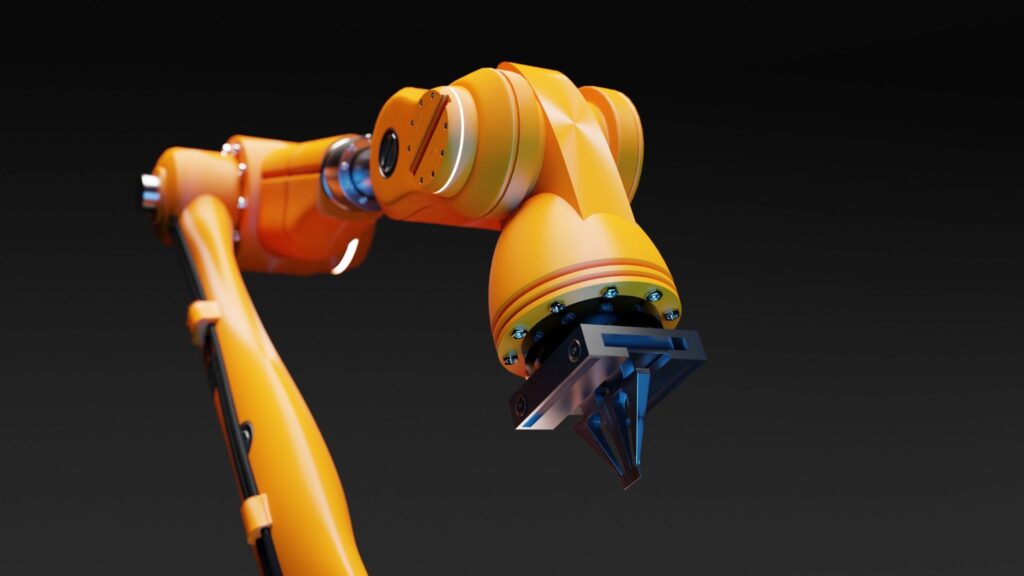
Accurate robot data annotation enables robotic arms to perform reliably. (Source: Pixabay)
The challenge is that annotating all of this robot data isn’t straightforward. Most traditional data annotation platforms were built for simpler computer vision tasks like image classification and object detection. They weren’t designed for the complexity of robotics workflows. Robotics teams need to annotate sequential actions, track changes in object states, and validate interactions across video frames and sensor data.
These are challenges our team has run into firsthand, and they are exactly what pushed us to build something better. TensorAct is our answer to that problem. Our multimodal data annotation platform supports complex robotics workflows through custom annotation templates, drag-and-drop pipeline building, and plugin-based integrations for external AI systems.
Let’s take a closer look at how TensorAct handles robot data annotation from the ground up.
Why Robotics Data Annotation Requires More Than Standard Tools
Before we dive into TensorAct, let’s understand why robotics annotation workflows are more complex than traditional labeling tasks.
Instead of identifying static objects in a single image, robotics teams are training systems to take actions in a constantly changing world. That is a fundamentally different challenge, and it shows up most clearly when you look at how complex the data actually is.
Take self-driving vehicles as an example. A self-driving car is essentially a massive robot that needs to predict human behavior, track motion, and understand intent over time. Every movement, reaction, and environmental shift in its surroundings has to be considered.
Because of this, a human annotator can’t just label objects with classes like ‘pedestrian.’ They have to track the context of where that pedestrian is moving, how fast they are walking, and where they might step next. The industry has responded by building specialized datasets designed specifically for capturing these fluid interactions.
A great example of this in action is the ROAD-Waymo dataset. It features 198,000 carefully annotated video frames and 12.4 million individual labels. By mapping out exactly how events unfold second by second, datasets like this give autonomous systems the situational awareness they need to navigate unpredictable real-world environments safely.
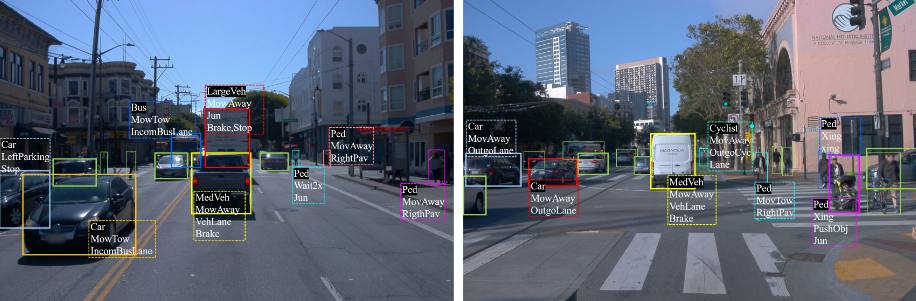
ROAD-Waymo Annotations Capture Agent, Action, and Location Data (Source)
This level of robot data annotation goes far beyond simple bounding boxes or tags. Teams have to track object interactions, motion paths, and changing object states across frame sequences while maintaining consistency. Standard annotation tools weren’t built for that kind of complexity, which is exactly why TensorAct is essential for robotics data annotation workflows.
Meet TensorAct: Built for Robotics Data Annotation at Scale
TensorAct is a multimodal data annotation platform built to handle the complexity of robotics and physical intelligence workflows. Unlike most annotation tools that support a single data type, TensorAct supports images, video, audio, text, and PDF files, giving robotics teams one centralized environment to manage diverse datasets without jumping between tools.
What sets TensorAct apart is the level of configurability it brings to every part of the annotation process. Teams can build and upload custom templates or annotation interfaces designed specifically for their data type and workflow.
Meanwhile, data annotation pipelines are constructed visually using a drag-and-drop workflow builder, where annotation stages, review layers, and approval routing can all be configured around the needs of the project. Also, support for multi-stage review workflows enables rigorous quality control.
On top of this, for robotics teams working with external AI systems, TensorAct’s plugin-based integrations make it possible for automation tools and machine learning pipelines to connect directly to annotation workflows through plugin nodes. This makes model-assisted labeling and API-based orchestration a natural part of the pipeline rather than a workaround.
In short, TensorAct bends to fit your robot data annotation needs, not the other way around. Next, let’s walk through how each of these capabilities works.
How TensorAct Custom Templates Support Robotics Data Annotation
TensorAct gives robotics teams the flexibility to upload custom templates for annotation, creating labeling environments designed specifically for their task, workflow, or data type. Complex robot data annotation needs purpose-built interfaces, not generic ones that teams have to work around.
Custom templates can be uploaded as ZIP packages containing HTML, CSS, JavaScript, JSON, and Liquid files. This gives teams full control over both the interface design and the underlying workflow logic. Once uploaded, templates connect directly to annotation stages within any workflow, making sure the right interface is always in front of the annotator at the right point in the pipeline.
For teams already using Amazon SageMaker Ground Truth, existing custom templates can be uploaded directly into TensorAct without rebuilding from scratch.
Annotating Multiple Robotic Actions in a Single Interface
Custom templates are especially useful for robotics workflows that involve multiple actions happening in sequence. Rather than fragmenting the annotation process across different tools or stages, TensorAct’s custom interfaces let teams review and label multiple robotic actions within a single environment.
Take a robot learning to fold a towel as an example. A single annotation screen can be set up to capture every action involved in that task at once, from picking up the towel and aligning the edges to folding, smoothing, and placing it down. Instead of switching between tools or stages for each action, annotators can work through all five steps in one place, staying focused and maintaining a clear understanding of how each action connects to the next.
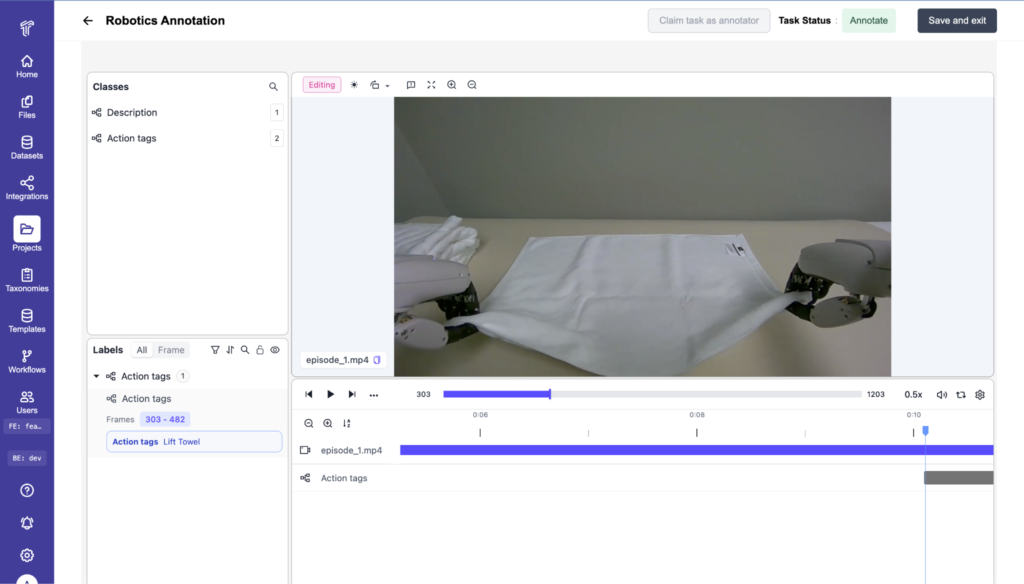
TensorAct Being Used to Label Robotic Actions from Video Data, like Folding Clothes
The level of configurability enabled by TensorAct makes it much easier to handle complex robotics tasks like motion tracking, sequential action labeling, multi-object interactions, and sensor-based workflows. And that flexibility extends beyond templates into how annotation pipelines themselves are built.
Building Robotics Annotation Pipelines with TensorAct
Another key feature of TensorAct is its customizable workflow builder, which gives robotics teams the freedom to design annotation pipelines that match the specific needs of their datasets, rather than working around the constraints of a rigid system.
Using a simple drag-and-drop canvas, teams can map out exactly how tasks move through the annotation process, from initial labeling through to final approval.
The platform supports multiple annotation stages, making it straightforward to handle complex robotics tasks like robot action labeling, motion tracking, object interactions, and sequential behaviors. Teams can layer in multiple review stages as needed to verify annotations, maintain consistency, and keep quality high across large datasets.
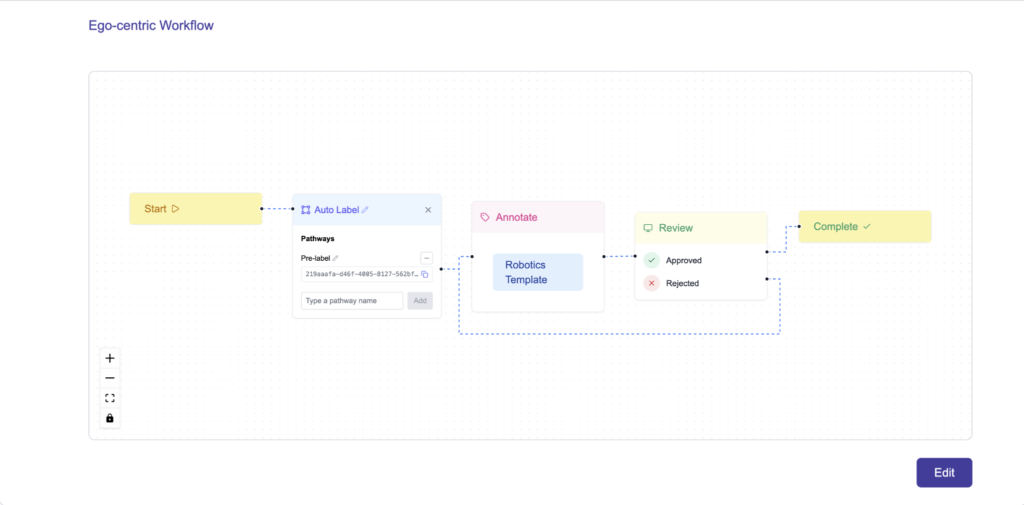
Creating Flexible Annotation Pipelines in TensorAct
TensorAct also supports approval and rejection routing, so tasks can move fluidly between annotators, reviewers, and quality assurance teams without manual intervention. This keeps the validation process organized and reduces the bottlenecks that slow down production workflows.
For robotics datasets that require repeated reviews and ongoing refinement, that flexibility becomes crucial. As dataset requirements evolve, workflows can be adjusted on the fly, helping teams scale annotation operations for even the most complex robotics and physical intelligence projects without rebuilding their pipelines from scratch.
Inside TensorAct: Workflow Nodes That Power Robot Data Annotation
TensorAct’s customizable workflows are built by connecting a set of purpose-designed workflow nodes, each handling a specific stage of the annotation process. Here is what each node does:
- Start Node: The Start node is the entry point of every workflow. Every task begins here before moving through the pipeline.
- Annotate Node: The Annotate node is where the actual labeling happens. Each Annotate node is linked to a custom template that defines what annotators see when they open a task. For complex robotics workflows, multiple Annotate nodes can be added to the same pipeline, supporting more than one round of labeling.
- Review Node: The Review node is where completed annotation tasks are sent for validation. It exposes two paths, one for approved tasks and one for rejected tasks, each of which can connect to any subsequent node in the workflow. Multiple Review nodes can be added for projects that require several rounds of quality control.
- Output Node: The Output node handles how completed annotations are formatted and prepared for export to downstream systems or external workflows once a task clears review.
- Plugin Node: The Plugin node is where the workflow hands tasks off to an external system or AI agent for processing. When a task reaches this node, the workflow pauses while the external system retrieves it, processes it, and returns it through a defined pathway ID. Each Plugin node supports up to five configurable pathways, giving teams flexible control over how tasks are routed after external processing.
- Complete Node: The Complete node marks the final stage of the pipeline. Once a task reaches this node, the annotation process is finished, and the task is marked as complete.
These nodes give robotics teams the building blocks to construct data annotation pipelines that reflect the real complexity of their robot data workflows.
Using Plugin Nodes to Automate Data Annotation for Robotics Workflows
So, how can a Plugin node make a real difference to your robotics data annotation workflow?
Consider a robotics team working through a large batch of video data. Rather than having human annotators label every frame from scratch, a Plugin node can hand tasks off to an AI pre-labeling system that automatically generates initial annotations.
The pre-labeled tasks are then pushed back into the workflow, where human annotators review and refine them instead of starting from zero. This can significantly reduce the time and cost of annotating large robotics datasets.
The same approach works for confidence-based routing. When an external AI system processes a task, it can use pathway IDs to route high-confidence predictions directly to the Output node while flagging lower-confidence results for human review. Annotators can spend their time where it matters most, reviewing genuinely uncertain cases rather than working through data that has already been labeled accurately.
For robotics teams, that means less time spent on repetitive labeling and more time focused on the annotations that actually need a human eye. The speed of automated processing and the accuracy of human review work together in one pipeline rather than fighting against each other.
Managing Multimodal Robot Data Collection and Annotation at Scale
Next-generation robotics systems don’t rely on a single type of data. A robot navigating a warehouse environment might pull from video feeds, depth sensors, audio inputs, and text-based logs all at once. Likewise, a surgical robot might combine instrument video, motion data, and spoken instructions to understand what is happening in the operating room.
This is what multimodal robot data looks like in action, and it is the norm rather than the exception for physical intelligence systems. The challenge for annotation teams is that managing all these data types across separate tools creates fragmentation that slows pipelines and introduces inconsistency in training data.
TensorAct supports video, images, audio, text, and PDF files within a single centralized platform, meaning robotics teams can manage different types of data in one place. No switching between tools for different data types, no reconciling annotations from separate systems, and no gaps in pipeline visibility. Everything lives in one environment, making it easier to maintain consistency and keep annotation operations running smoothly as datasets grow.
The Real Cost of Rigid Tools for Physical AI Data and Robotics Annotation
Building physical intelligence systems is not a one-and-done task. Unlike traditional AI systems that operate within relatively fixed parameters, robotics pipelines are constantly shifting as robots learn, encounter new environments, and take on more complex tasks.
Over time, teams need to fine-tune annotation rules, add review steps, update interfaces, or adapt to entirely new robot behaviors. With a rigid labeling system, even a small change can force you to tear down your entire workflow and rebuild it from scratch. That kind of disruption doesn’t just slow teams down. It kills momentum at exactly the moment when consistency matters most.
That is why flexibility is not a nice-to-have for robotics annotation teams. It is essential. TensorAct’s customizable templates and configurable workflows are built to grow alongside your robots, so teams can pivot and adapt without breaking what is already working.
When workflows are being disrupted by hardware updates, new training goals, or unexpected edge cases from real-world testing, you need infrastructure that can bend without breaking. TensorAct keeps your physical AI data consistent, your team focused, and your annotation pipeline moving forward, no matter how much your datasets grow or your requirements change.
Ready to build smarter, more adaptable physical intelligence systems? Book a demo today and see TensorAct in action.
Frequently Asked Questions
- What is robot data?
- In robotics, data includes information like sensor readings, video footage, and labeled actions that robots use to learn, adapt, and perform complex tasks.
- What data do robots use?
- Sensors like cameras, LiDAR, and accelerometers collect raw information about the robot’s surroundings. This data is then processed into a structured format using methods like analog-to-digital conversion, noise filtering, and coordinate transformations.
- What is robotics annotation?
- Robotics data annotation is the process of labeling multi-modal sensor data to train embodied AI systems, or machines that physically interact with their environment. Unlike traditional computer vision tasks, robotics annotation involves understanding actions, movement, spatial relationships, and real-world interactions.
- What are the 5 types of robots?
- The five main types of robots are pre-programmed robots, humanoid robots, autonomous robots, teleoperated robots, and augmenting robots. Each type serves a different purpose, from performing repetitive industrial tasks to assisting humans in dangerous or physically demanding environments.
One Data Annotation Platform for Every Data Type
Annotate image, video, text, audio, and PDF data without switching tools or rebuilding what already works.