Simplify Your Data Annotation Workflows with TensorAct

Organizations lose at least $12.9 million every year to something entirely preventable: poor data quality. For companies building robotics and automation systems, that cost is directly tied to how well their systems are trained.
Most automated systems are trained on annotated data, meaning every label, marking, and classification in a training dataset directly shapes how a robot interprets objects, movements, and spatial changes in the real world. When that data is accurate and consistent, systems perform as expected. When it isn’t, even minor labeling errors lead to deployment failures, costly rework, and operational downtime.
This is a challenge that extends well beyond robotics. Across healthcare imaging, autonomous vehicles, and industrial automation, organizations managing large-scale data annotation pipelines face the same underlying problem.
Annotation tasks, review stages, approvals, custom interfaces, and external systems are often handled across multiple disconnected tools. When this happens, teams spend more time managing tools than managing quality, and as AI data annotation demands grow, that gap only widens.
TensorAct, our multimodal AI data annotation platform, was designed specifically to solve that problem. It brings dataset management, drag-and-drop workflows, custom annotation templates, and plugin-based AI agent integration into a single system, so annotation teams spend less time managing tools and more time building better data.
Behind Every AI Innovation Is a Data Annotation Problem
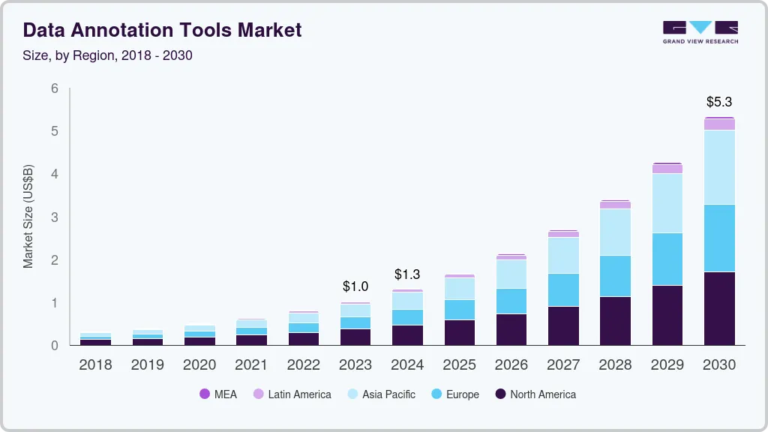
While there is plenty of buzz about new AI innovations, with new models and breakthroughs emerging almost every week, the silent foundation driving all of it is high-quality annotated data. In fact, the global data annotation tools market is projected to reach $5.3 billion by 2030. As that demand grows, so does the need for infrastructure that can support it.
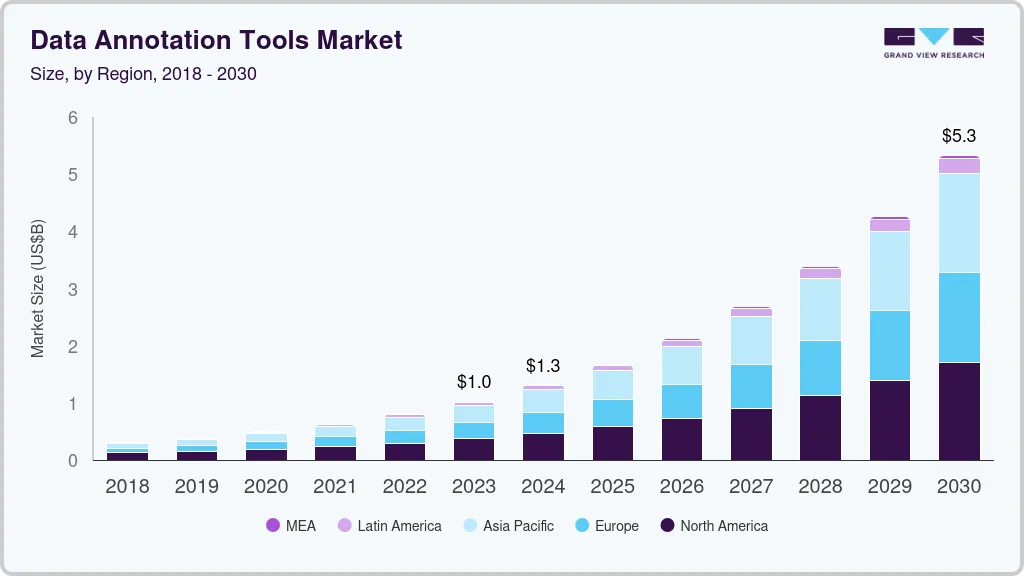
The Global Data Annotation Tools Market (Source)
Our team has spent the past five years delivering AI projects across robotics, healthcare imaging, and industrial automation. Along the way, we’ve used every major data annotation platform available.
We found that most platforms were great at one part of the data annotation pipeline but required manual workarounds for the rest. They handle the labeling itself reasonably well, but everything around it, managing datasets, coordinating review stages, maintaining pipeline visibility, and building interfaces suited to the task, is either rigid, disconnected, or missing entirely.
Where Most Data Annotation Platforms Fall Short
Here are a few of the main issues we kept seeing with traditional data annotation tech:
- Disconnected Tools and Limited Pipeline Visibility: Teams end up managing datasets in one place, tracking task progress in another, and coordinating review operations manually across tools that were never designed to work together. As projects grow, that fragmentation creates operational delays that are difficult to recover from. A team annotating LiDAR data for an autonomous vehicle project, for instance, shouldn’t need three separate platforms to manage files, track task status, and coordinate reviewer assignments.
- Fixed Review Structures that Slow Down Quality Control: Annotation review isn’t one-size-fits-all. A healthcare team labeling medical imaging data may need three rounds of specialist review before a label is approved. A simpler classification project may need none at all. Rigid review workflows can’t accommodate that variation. When the platform can’t adapt, teams work around it manually, and quality control slows down as a result.
- Generic Annotation Interfaces that Do Not Work for Specialized Projects: Predefined interfaces are built for general use cases. But robotics footage, medical imaging, 3D spatial data, and egocentric video each require annotation environments designed around the task itself. When annotators are working in an interface that wasn’t built for the data in front of them, annotation slows down, and consistency becomes harder to maintain.
That’s why we built TensorAct, a multimodal AI data annotation platform designed from the ground up to handle the full scope of annotation work within a single system. It is easy to use, cost-effective, and built to flexibly adapt to the needs of any annotation pipeline.
What Makes TensorAct Different From Other Data Annotation Tech
Most data annotation platforms are built around just data labeling. Everything else, workflow coordination, quality control, custom interfaces, and external integrations, is either an afterthought or left out entirely. As annotation pipelines grow in scale and complexity, those gaps create operational overhead that slows teams down and drives up the cost of maintaining data quality.
TensorAct was built around a different philosophy. Instead of solving one part of the pipeline well and leaving the rest to workarounds, TensorAct brings the following key capabilities together in a single system:
- Dataset and File Management: Teams can upload, organize, and manage files and datasets directly within the platform, with native AWS S3 integration for large-scale cloud-based workflows.
- Task Visibility and Pipeline Oversight: A dedicated Tasks view gives teams a clear picture of task status, assignments, review ownership, and progress across the entire pipeline in one place.
- Configurable Drag-and-Drop Workflows: Workflows are built on a visual canvas, giving teams the flexibility to configure pipelines, review stages, and routing around the needs of the project rather than the constraints of the platform.
- Custom Annotation Templates: Teams can upload custom annotation interfaces, giving annotators an environment designed specifically for the data type and task at hand.
- Plugin-Based AI Agent Integration: External AI systems can connect to the pipeline natively through Plugin nodes, retrieving tasks, processing them externally, and returning them through defined pathways without disrupting the rest of the workflow.
Next, we’ll walk through how each of these capabilities works inside TensorAct and where they make the most impact.
Managing Files, Datasets, and Projects in TensorAct
Before any data annotation work can begin, data needs to be in the right place. TensorAct gives teams a structured way to bring files in, organize them into datasets, and connect everything into a single project, whether files are coming from a local machine or a cloud-based storage system.
Files can be uploaded directly from a local machine through the Files section, or imported from a connected AWS S3 bucket for teams working with large cloud-based datasets. Once uploaded, the platform stores a full copy and makes it immediately available for use. From there, files are organized into datasets, named collections grouped by data type, such as PDF or video, that can be reused across multiple projects as needed.
Projects bring all of these components together. Teams create projects directly within the platform by combining workflows, datasets, and users into a single operational setup.
Once a project is active, the Tasks tab provides a real-time view of task status, assignments, review ownership, and the latest updates across the pipeline, giving teams the visibility they need to manage large annotation operations without losing track of progress.
TensorAct’s AWS S3 Integration for Scalable File Management
For teams managing large cloud-based datasets, manually moving files between storage systems is time-consuming and creates unnecessary operational overhead. TensorAct’s AWS S3 integration removes that step entirely. Once connected, teams can pull files directly from their S3 bucket into the platform without downloading or re-uploading anything.
Rather than making a copy of every file, TensorAct simply points to where the file already lives in S3. This keeps things clean and ensures the platform is always working with the right version of the data. Teams can also bring in entire folders at once by pasting an S3 folder path, making it quick and straightforward to import large batches of files at once.
Building Flexible AI Data Annotation Workflows in TensorAct
Every data annotation project has its own rhythm. Some move through a single labeling stage and straight to output. Others require multiple rounds of annotation, specialist review, and structured approval before a task is considered complete. The pipeline that works for one project can be entirely wrong for another.
TensorAct is built around that reality. Data annotation workflows can be constructed on a visual drag-and-drop canvas, where teams connect nodes to define the exact path a task will take. Nothing is fixed in advance. Your data annotation pipeline is configured around the project, not the other way around.
TensorAct Lets You Build Customizable Workflows
Most data annotation tech locks teams into a fixed pipeline structure. When a project needs something different, teams work around it manually. TensorAct removes that constraint. Teams can build the data annotation pipeline their project actually needs, connect the right nodes in the right order, and adjust it as requirements change.
Core Workflow Nodes in TensorAct
Workflows in TensorAct can be built by combining five types of nodes. Here’s a quick look at what each one does:
- Start Node: This is where every task enters the workflow. Think of it as the starting line; everything flows forward from here.
- Annotate Node: This is where the actual annotation work happens. Each Annotate node is linked to a custom template that defines what annotators see when they open a task. Multiple Annotate nodes can be added to the same workflow for projects that require more than one round of labeling.
- Review Node: Once a task is annotated, it moves to a reviewer who either approves or rejects it. Approved tasks move forward in the pipeline, while rejected tasks can be routed back for correction. Multiple Review nodes can be added for projects that require several rounds of quality control.
- Output Node: This node handles how completed annotations are formatted and exported before they are sent to downstream systems or external workflows.
- Plugin Node: When a task reaches this node, the workflow pauses and hands the task off to an external system or AI agent for processing. Once the external system is done, it returns the task through a defined pathway, and the workflow continues.
- Complete Node: This is the finish line. Once a task reaches this node, the annotation process is done, and the task is marked as complete.
Configurable Review Paths within TensorAct
How a data annotation team handles reviews can make or break an annotation pipeline. TensorAct gives teams the flexibility to build a review process that actually fits the way they work.
Review nodes give teams control over how tasks move through the pipeline. Each node exposes two paths, one for ‘Approved Tasks’ and one for ‘Rejected Tasks’, and each path can connect to any subsequent node in the workflow.
Consider a team annotating medical imaging data. A task that passes review moves forward to the Output node. A task that is rejected gets routed back to the annotator for corrections, then passes through a second specialist review before it can move forward again. That entire process is configured directly within the workflow, with no manual intervention or external coordination needed.
The same flexibility applies across any project type. A simpler classification project might route rejected tasks straight back to the annotator with no additional review stage. A more complex robotics dataset might require three rounds of validation before a label is approved. TensorAct accommodates both, without requiring any workarounds.
Using Custom Templates for Specialized Annotation Tasks
Not every annotation task can be handled with a generic interface. Some projects involve highly specialized data that requires an environment built around the task itself. Egocentric video annotation for robotics is a good example of this.
Egocentric video is footage captured from a person’s or a robot’s own point of view. When training a robot to perform tasks like folding a towel or picking up an object, that footage can span hundreds of frames, and each stage of the task needs its own annotations, frame ranges, and action labels.
In a generic annotation interface, managing that level of detail is tricky. Annotation slows down, review becomes harder to coordinate, and maintaining consistency across the pipeline becomes more challenging.
TensorAct’s support for custom templates makes a huge difference here. Rather than asking annotators to work within a predefined environment that wasn’t designed for the data in front of them, teams can upload a template tailored to their exact workflow into TensorAct, giving them complete control over what annotators see and interact with during the labeling process.
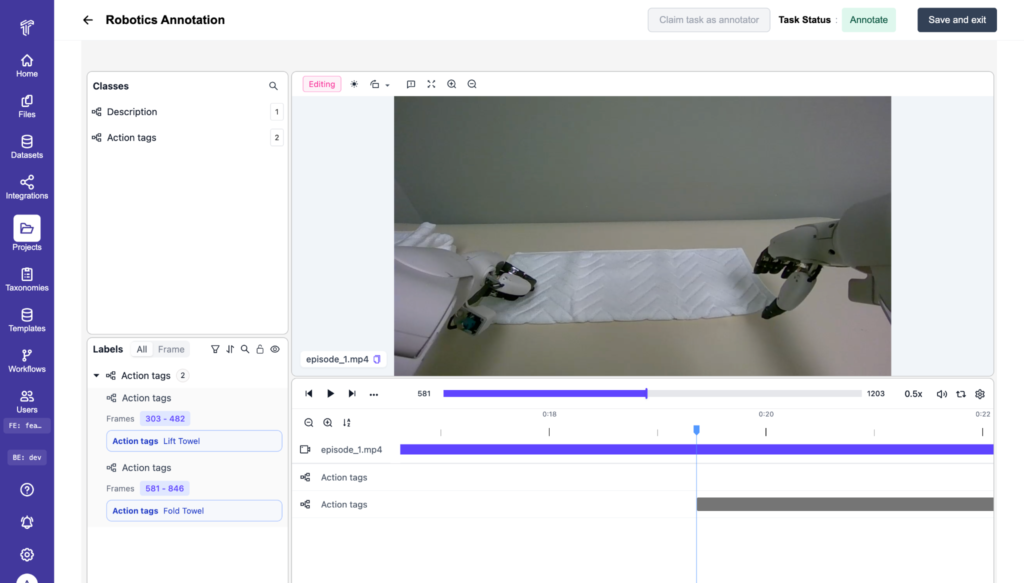
An Example of Annotating Robotics Data Using a Custom Template inside TensorAct
TensorAct accepts custom templates uploaded as .zip files through the Templates page. Supported file types include HTML, CSS, JavaScript, JSON, and Liquid, with at least one HTML file required. Once uploaded, a template can be connected directly to an Annotate node within a workflow, making it straightforward to use the right interface at the right stage of the pipeline.
This flexibility extends beyond robotics. Whether the project involves medical imaging, 3D spatial data, or audio-visual annotation, teams can upload an interface that matches the specific demands of the data type and task, rather than adapting their workflow to fit a generic environment.
Migrating Amazon SageMaker Ground Truth Templates into TensorAct
For teams already using custom templates within Amazon SageMaker Ground Truth, moving to TensorAct is straightforward. TensorAct supports the direct upload of existing SageMaker Ground Truth custom templates, so teams can keep using the annotation interfaces they already built without starting from scratch.
This means there is no disruption to existing workflows. Teams can upload their templates directly into TensorAct and pick up where they left off, without spending time rebuilding interfaces or reconfiguring annotation environments.
Extending TensorAct Workflows with Plugin Nodes
AI agents and systems are quickly becoming a core part of data annotation pipelines. Teams use them to pre-label data, flag low-confidence predictions for human review, and automate repetitive labeling tasks before annotators step in.
TensorAct is built to support that. Plugin nodes act as handoff points between TensorAct and external AI systems, making it possible for users to bring those systems directly into the annotation workflow without building custom integrations from scratch.
Here’s a closer look at how it works:
- When a task reaches a Plugin node, the workflow pauses and waits for the external system to take over.
- The external system retrieves the task through TensorAct’s List Tasks API, processes or labels it externally, and pushes it back into the platform along with the processed data and a target pathway ID.
- TensorAct then matches the pathway ID, updates the task with any returned labels, and routes it to the next stage in the workflow.
TensorAct’s Plugin feature enables human annotators and external systems to work together within the same pipeline, with each handling the data annotation stages they are best suited for.
How Pathway-Based Routing Works
Let’s look at how pathway-based routing works and how it gives teams control over where tasks go next.
Each Plugin node can have up to five pathways configured inside it. Every pathway has a unique system-generated ID that is provided to the external system, and each pathway connects to a different node in the workflow.
Consider an AI agent pre-labeling a batch of robotics data annotation tasks. Some tasks are labeled with high confidence, while others carry more uncertainty. Pathway routing determines where each task moves next based on that outcome.
For instance, a confident label may move directly to the Output node, and a lower-confidence prediction is routed to a human Review node instead. The decision is made by the external system at the time of submission, and the workflow adapts accordingly.
This means a single Plugin node can branch a workflow in multiple directions, all based on what the external system finds. Different outcomes lead to different paths, without any manual intervention needed to redirect tasks.
For this process to work correctly, the pathway ID used in the push API call has to exactly match the ID generated by the platform. TensorAct exposes each pathway ID directly within the Plugin node configuration and includes a copy option for quick access. This makes it easier for external systems to reference the correct route during submission.
Where TensorAct’s Workflow Flexibility Matters Most
As you explore TensorAct’s key features, you might wonder how they translate to real annotation operations. Simply put, data annotation challenges look different across industries, but the problem is almost always the same. Teams end up building their workflows around the limitations of their tools, rather than the other way around.
For instance, for enterprise teams managing large annotation pipelines, scale exposes every weakness in a rigid system. As data volumes grow, the cost of managing datasets, tracking task progress, and coordinating file imports across disconnected tools adds up quickly. TensorAct gives these teams the operational foundation to grow without the overhead.
Similarly, for robotics teams, the annotation interface is crucial. A segmentation pipeline for a robot navigating a warehouse environment requires precise boundary annotations in every frame, and annotators need an environment designed around that task. Generic interfaces slow down work and introduce inconsistencies that are difficult to recover from. Custom templates in TensorAct put that control back in the team’s hands.
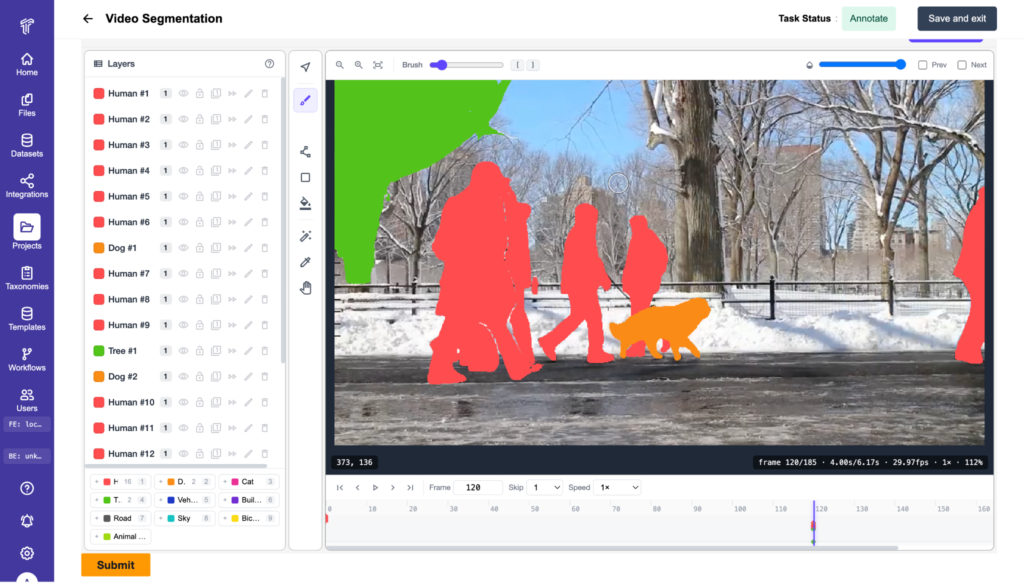
A Custom Template for Video Segmentation within TensorAct
Meanwhile, healthcare teams know better than most that reviews aren’t a formality. Medical imaging annotation often requires multiple rounds of specialist validation, and a single linear review process rarely holds up under that pressure. TensorAct’s configurable review workflows give teams the structure to enforce the level of quality control the work demands.
Also, for teams bringing external AI systems into their pipelines, the coordination challenge is real. Human annotators and automated systems need to work in sequence without manual handoffs slowing everything down. TensorAct’s Plugin nodes make that seamless, routing tasks between systems automatically and keeping the pipeline moving.
Data Annotation Complexity is a Workflow Problem
Running a data annotation pipeline well is harder than it looks. Labeling is only one part of the process. Datasets, review stages, custom interfaces, and external integrations all need to work together, and when they don’t, data quality suffers.
As pipelines grow, that coordination challenge grows with them. When these pieces are spread across disconnected tools, operational overhead builds quickly, and the quality of training data begins to reflect it.
TensorAct is built to bring all of that together. Rather than managing each piece separately, annotation teams have everything they need in one place, from dataset management and configurable workflows to custom annotation templates and external integrations.
Ready to bring your annotation pipeline into one place? Get started with TensorAct today or schedule a demo to see it in action.
Frequently Asked Questions
- What is data annotation?
- Data annotation is the process of labeling raw data, such as text, images, audio, or video, to make it usable for AI and machine learning models. These labeled datasets give models the structured examples they need to learn from, recognize patterns, and make accurate predictions.
- What are the 4 major benefits of data annotation?
- Data annotation improves the quality of AI training data by giving models clear, structured examples to learn from. It helps models recognize patterns more accurately, reducing errors in real-world performance. It also makes it possible to train models across different data types, from images and video to audio and sensor data. And when annotation is done consistently and at scale, it directly improves the reliability of AI systems’ performance in production environments.
- What is an example of data annotation?
- For example, consider a robotics team training a robot to sort objects on a conveyor belt. Annotators label each video frame, marking the position, size, and type of every object the robot needs to identify. This labeled data is then used to train the robot to recognize and handle those objects accurately in a real warehouse environment.
- What does an AI data annotator do?
- An AI data annotator reviews and labels raw data to help AI models understand what they are looking at. Depending on the project, this could involve tagging objects in images, marking actions across video frames, transcribing audio, or flagging errors in model outputs. Their work sits at the foundation of every AI system, directly influencing how accurately a model performs once it is deployed.
One Data Annotation Platform for Every Data Type
Annotate image, video, text, audio, and PDF data without switching tools or rebuilding what already works.