Exploring Smarter Medical Data Annotation With TensorAct


According to a 2026 survey of healthcare leaders, 63% of organizations now run AI in at least one live workflow. Yet 62% say fragmented data systems are still their biggest barrier to scaling it further.
A large part of that fragmentation starts with medical data annotation. Medical images, clinical records, videos, and audio files all need to go through structured annotation and review workflows before they can be used as healthcare AI training data.
As projects scale, that process grows more complex. Data moves between annotators, reviewers, and supervisors across multiple stages, and teams often end up juggling disconnected tools just to keep things moving.

Quality data annotation drives reliable healthcare AI. (Source: Pexels)
TensorAct was built specifically for this challenge. As a cutting-edge data annotation platform, TensorAct brings dataset organization, flexible review workflows, and custom annotation interfaces or templates into a single environment, so teams spend less time managing tools and more time building better data.
Let’s break down why medical data annotation is uniquely complex, and how TensorAct helps teams manage it more efficiently at scale.
What Makes Medical Data Annotation So Complex?
At first glance, medical data annotation may look like any other labeling project. Data comes in, annotators review it, labels are added, and the dataset moves into model training. In reality, the workflow is far more layered than that.
Healthcare AI training data is often multimodal, meaning teams work with several types of medical data within the same pipeline. This can include medical images, DICOM (Digital Imaging and Communications in Medicine) scans, clinical records, PDFs, audio files, and surgical videos, all handled within a single project.
Each data type comes with its own review process, tooling requirements, and level of specialist involvement, making healthcare annotation workflows far more complex than standard data labeling pipelines.
How Medical Data Annotation Review Requirements Vary
The review process for medical data labeling is unique to each task. Some annotations only need a quick check before moving ahead. Others may need several specialists to review the same piece of data to make sure everything is accurate for AI training.
That is why human-in-the-loop workflows are so important for AI in healthcare. Medical experts stay involved throughout the review process, helping verify annotations instead of leaving everything to automation.
That attention to detail and maintaining review quality can have a major impact on model performance later on. For example, in a study on osteosarcoma (bone cancer) detection, researchers found that AI models trained on lower-quality annotations achieved only 60–70% sensitivity. After retraining the same model using expert-annotated data, sensitivity increased to 95.52% and specificity reached 96.21%.
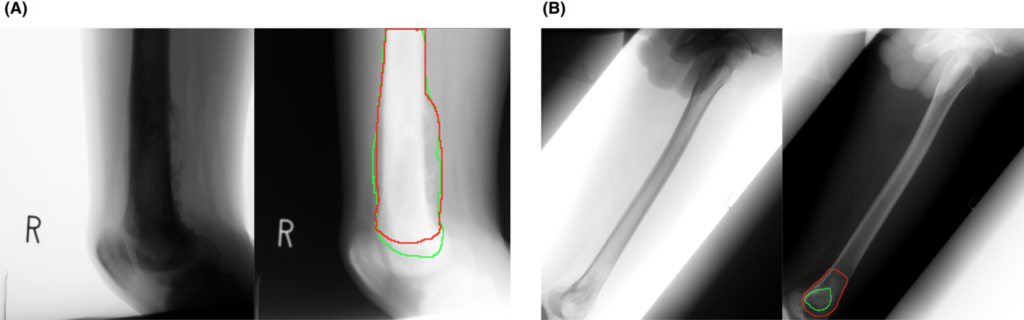
Lesion Detection: Expert-Annotated Boundaries (Red) vs. AI Segmentation (Green) (Source)
These results show how much review quality matters in healthcare annotation. But maintaining that standard becomes harder as projects grow. Teams often end up relying on spreadsheets, manual follow-ups, and disconnected tools just to keep datasets, reviews, and approvals moving between stages.
Medical Data Annotation Across Healthcare Domains
A key reason healthcare annotation workflows are tricky to manage is that every project operates differently. The data, the review process, and the level of specialist involvement change depending on what the AI system is being trained to do.
Here are some common healthcare AI training data workflows teams work with today:
- Radiology Annotation Workflows: Radiology projects involve labeling medical imaging annotation datasets, including DICOM files. DICOM annotation requires interfaces built to handle multi-frame imaging data and embedded metadata alongside the scan itself. Structures, boundaries, abnormalities, and regions of interest have to be annotated consistently across large volumes of scans.
- Pathology Annotation Workflows: These workflows focus on high-resolution tissue samples. Small differences in cell structures and classifications have to be labeled with very high precision.
- Clinical Data Annotation: Clinical data projects involve patient records, discharge summaries, and healthcare documentation. Both structured and unstructured text need to follow clearly defined labeling standards.
- Medical Speech Annotation: Speech annotation workflows involve clinical conversations, physician dictations, and diagnostic recordings. Transcription accuracy, speaker separation, and timing all play an important role.
- Surgical Video Annotation: Surgical video projects often require teams to label long procedural recordings frame by frame. This can include surgical stages, instrument interactions, and actions taking place throughout the procedure.
Each of these workflows runs differently. Some projects may require multiple rounds of data-annotation specialist review before annotations are approved, while others rely on entirely different annotation interfaces or validation steps. These variations make medical data annotation workflows harder to standardize across projects.
Managing Healthcare AI Training Data Across Multiple Data Types
Before healthcare teams can annotate anything, they have to bring the data together first. That sounds straightforward until files start coming in from different hospital systems, storage platforms, and departments at the same time.
A single medical AI system can involve radiology scans, clinical PDFs, patient records, medical images, audio files, and procedural videos, all moving through the same pipeline. Some datasets may already exist in cloud storage, while others are uploaded manually from internal systems. Instead of working with a single, clean data source, teams often pull information from multiple environments at once.
In addition to this, the scale of healthcare data makes it even harder to manage. One report estimated that the healthcare industry generates nearly 30% of the world’s total data volume, largely driven by medical imaging, electronic health records, and connected health devices.
TensorAct Keeps Healthcare AI Training Data Organized at Scale
TensorAct helps healthcare teams manage this complexity by bringing dataset management and annotation workflows into a single platform. Instead of juggling multiple storage systems and tools, teams can organize, manage, and prepare healthcare AI training data within a centralized environment.
Files can be uploaded directly or imported from AWS S3, making it easier to bring together medical images, clinical documents, patient records, audio recordings, and videos from different sources. For larger projects, entire folders can be imported from connected S3 buckets, streamlining the onboarding of large datasets.
By keeping dataset organization, storage integrations, and annotation workflows connected, TensorAct enables healthcare teams to spend less time managing data and more time producing high-quality training data for medical data annotation projects.
Building Smarter Medical Data Annotation Workflows
As we’ve seen earlier, reviews play a much larger role in healthcare annotation than in many standard labeling projects.
For example, brain tumor segmentation involves outlining tumor boundaries within MRI scans, so AI models can learn to distinguish cancerous tissue from healthy tissue. But getting those boundaries right usually requires several review stages, not just a single validation pass.
In a recent study on brain tumor segmentation, initial segmentations were first generated automatically, then refined by expert radiologists, and finally reviewed by senior neuroradiologists before the labels were approved. This level of review is important because annotation mistakes in healthcare can directly affect diagnostic outcomes, not just dataset quality.
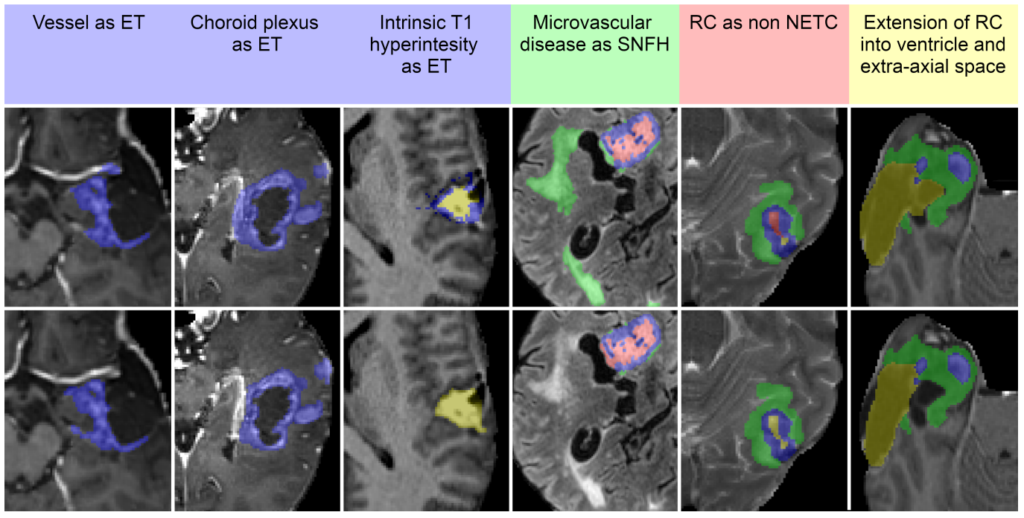
Automated vs. Expert-Corrected Brain Tumor Segmentation (Source)
That’s where rigid annotation systems often start creating problems. Healthcare projects rarely follow a single fixed review process, and workflows become difficult to manage when multiple specialists and approval stages are involved.
TensorAct takes a more flexible approach to workflow management. One of its core features is a visual drag-and-drop workflow builder that lets teams create review pipelines based on the way their projects already operate. As review stages or validation requirements change, workflows can be updated without rebuilding the entire process.
Core TensorAct Workflow Nodes Used in Healthcare Projects
Here are the key nodes used to build healthcare annotation workflows in TensorAct:
- Start node: Every task enters the workflow here before moving into the stages configured by the team. It acts as the fixed starting point of the pipeline.
- Annotate node: This node provides an annotation interface tailored to the data type, whether medical imaging annotation, clinical text, or video. Multiple Annotate nodes can be added to support different labeling rounds.
- Review node: After annotation, tasks move into review, where specialists validate the work. Reviewers can approve a task, move it forward, or reject it for correction. Multiple Review nodes can also be stacked together for layered validation workflows.
- Output node: Once a task has cleared all annotation and review stages, the Output node prepares the completed labels for export to downstream systems or AI training pipelines.
- Plugin node: This node allows external systems and AI agents to connect directly into the workflow. Teams can use it for tasks like AI-assisted pre-labeling or external task processing before the workflow continues.
- Complete node: The final stage of the pipeline. Once a task reaches this node, the medical data annotation workflow is officially finished.
Custom Templates for Medical Image Annotation Tasks in TensorAct
Medical data annotation projects don’t always fit neatly into standard annotation interfaces. Different types of medical data often need different layouts, labeling tools, and review setups depending on the workflow.
That is where TensorAct’s custom template feature becomes useful. Instead of forcing teams into a fixed annotation interface, TensorAct allows users to upload and use custom annotation templates that match their existing workflows and data requirements.
This is especially vital for DICOM annotation and other specialized medical imaging workflows, where standard annotation interfaces may not support the file structures, imaging views, metadata, or review requirements teams need. Rather than adapting workflows to a rigid interface, teams can deploy custom templates tailored to their annotation process and connect them directly to TensorAct workflows.
Existing custom templates from Amazon SageMaker Ground Truth, AWS’s managed data labeling service, can also be imported directly into TensorAct instead of being rebuilt from scratch.
Connecting External Systems Through Plugin Nodes within TensorAct
As healthcare AI projects scale, not every annotation task requires the same level of human involvement. Some cases may need detailed review from specialists, while others can be partially automated before reaching a reviewer.
For example, a dental AI model trained to identify implants, crowns, root canals, and fillings could be connected to TensorAct through a Plugin Node. Instead of starting with a blank X-ray, incoming images could first be analyzed by the model, which generates preliminary annotations for the dental structures it detects.
Dental specialists would then review those predictions, correct any inaccuracies, and validate more complex cases. This allows experts to focus their time on quality control and difficult edge cases rather than manually labeling every image from scratch.
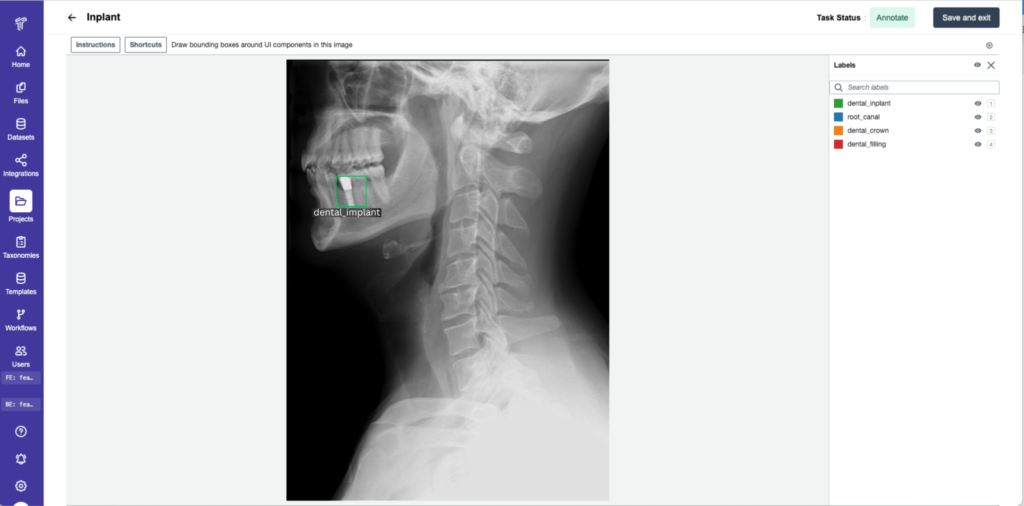
An Example of Annotating Dental Structures on an X-Ray Using TensorAct
TensorAct supports these AI-assisted workflows through its Plugin Node feature. When a task reaches a Plugin Node, it can be sent to an external AI model or agent for processing before returning to the workflow. The platform then routes the task based on the result. High-confidence predictions can move directly to the next stage, while uncertain or complex cases can be sent to specialist reviewers for validation.
Each Plugin Node supports up to five configurable pathways, giving teams precise control over how tasks move through annotation, review, and approval stages. This allows organizations to combine automation and human expertise within a single medical data annotation workflow.
Managing Healthcare Annotation Teams at Scale
Features like customizable workflows, custom annotation templates, and Plugin Nodes help healthcare teams build annotation processes around their specific requirements. As projects grow, however, effective team management becomes just as important as workflow design.
TensorAct includes a dedicated Teams tab within each project, letting organizations assign roles such as annotator, reviewer, project supervisor, and project viewer. Access is managed at the project level, ensuring team members only see the tasks and workflow stages relevant to their responsibilities.
By combining role-based access with flexible workflows, TensorAct helps healthcare teams keep annotation, review, and approval processes organized as medical data annotation projects scale.
Rigid Medical Imaging Annotation Tools Slow Teams Down
As we’ve seen throughout this article, healthcare annotation workflows rarely follow a single process. Different projects require different datasets, review stages, annotation interfaces, external AI systems, and team structures.
Managing that complexity becomes difficult inside rigid annotation tools. Teams often end up creating workarounds just to keep workflows moving when annotation interfaces, review pipelines, and external systems need to operate together.
The impact of annotation quality is already evident in clinical AI. For instance, in a large-scale mammography screening study, AI models trained on high-quality annotated imaging data reduced false positives from 2.39% to 1.63% and lowered unnecessary patient recalls by 20.5%, improving detection accuracy while reducing avoidable follow-up procedures.
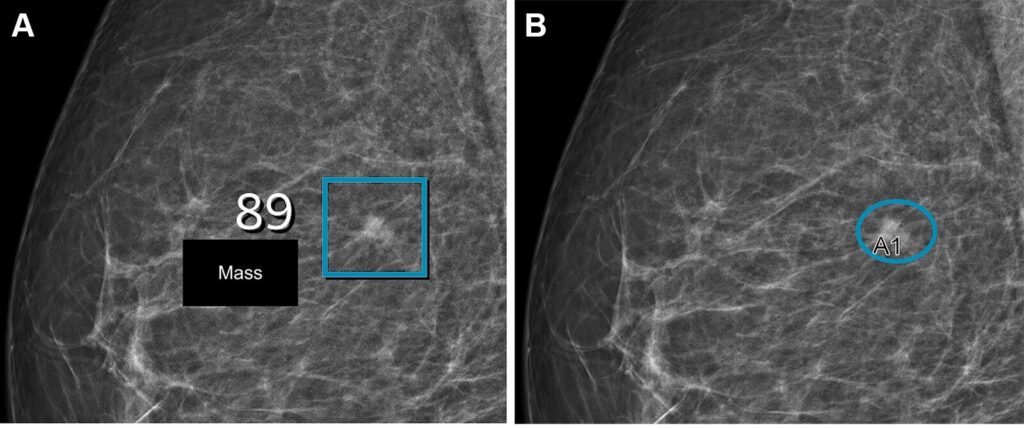
AI-Assisted Breast Cancer Detection in Mammography Scans (Source)
This is exactly why workflow flexibility matters in healthcare AI. TensorAct makes it easier for teams to adjust review stages, use custom medical image annotation interfaces, connect external AI systems, and manage workflows around how their projects actually operate instead of adapting projects around rigid tooling.
Stop Working Around Your Annotation Tool. Try TensorAct.
Healthcare AI systems depend on training data that is accurate, consistent, and reviewed throughout the annotation process. Building and maintaining that data requires more than basic labeling tools.
As we’ve seen, healthcare teams often need to manage multiple data types, complex review workflows, custom annotation interfaces, external AI systems, and large annotation teams within the same project. Platforms built around rigid workflows can make that complexity harder to manage as projects scale.
TensorAct brings these capabilities together in a single healthcare data annotation platform. From dataset management and customizable workflows to custom templates, Plugin nodes, and role-based team controls, the platform gives organizations the flexibility to build annotation processes around their operational needs while maintaining high-quality healthcare AI training data.
Want to see how TensorAct supports complex medical data annotation workflows? Book a demo to explore the platform and see how it fits into your AI pipeline.
Frequently Asked Questions
- What is medical data annotation?
- Medical data annotation is the process of labeling healthcare data like medical images, clinical records, and surgical videos so AI models can learn from it. The annotated data helps healthcare AI systems recognize patterns and improve accuracy.
- What are medical imaging tools?
- Medical imaging tools are technologies used to capture images of the body for diagnosis and treatment. Common examples include X-rays, CT scans, MRI, ultrasound, PET scans, and fluoroscopy.
- What is a data annotation platform?
- A data annotation platform is a tool used to label and organize data like images, text, audio, and video for AI training. It helps teams manage annotation workflows, reviews, and datasets more efficiently while preparing training data for machine learning models.
- What does DICOM stand for?
- DICOM stands for Digital Imaging and Communications in Medicine. It is the standard format used to store, share, and manage medical imaging data like X-rays, MRIs, CT scans, and ultrasounds across healthcare systems.
- How is AI used in medical healthcare?
- AI is used in healthcare to analyze medical data, support diagnosis, improve workflows, and assist with treatment planning. It can help detect diseases from medical images, process clinical records, automate repetitive tasks, and support faster decision-making for healthcare teams.
One Data Annotation Platform for Every Data Type
Annotate image, video, text, audio, and PDF data without switching tools or rebuilding what already works.