Bounding Boxes vs. Segmentation: Which One Should You Use?
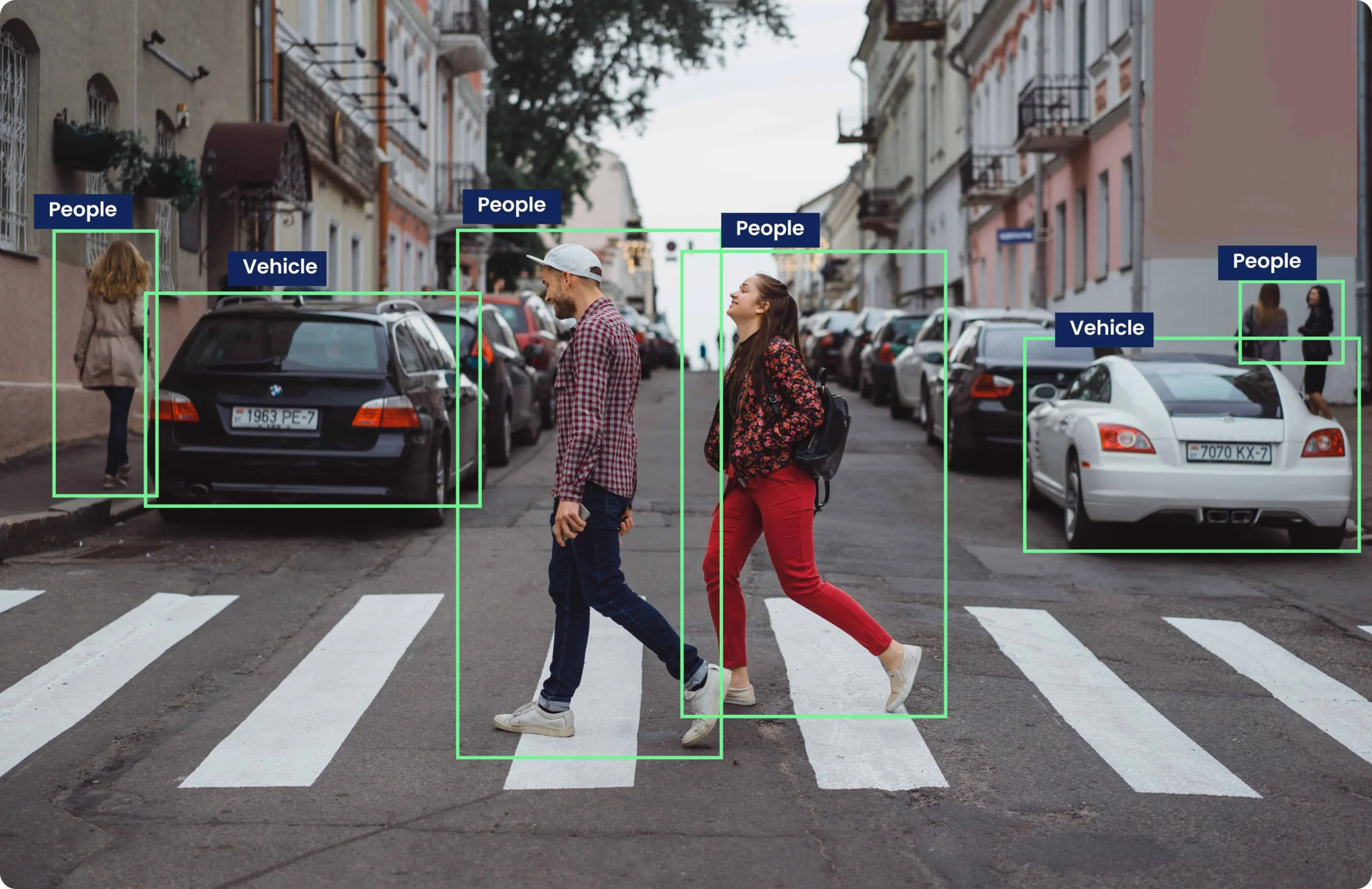

Every computer vision project begins with the same question: how should you annotate your data? For many teams, the choice comes down to two of the most common annotation methods—bounding boxes and segmentation. While both help AI models understand objects within an image, they serve very different purposes and directly impact model performance, annotation speed, and project costs.
Choosing the wrong method can lead to unnecessary labeling effort or limit what your model is capable of learning. Understanding where each technique works best helps you build better datasets from the very beginning.
The right annotation method isn't the most precise one—it's the one that best matches your model's objective.
Understanding Bounding Boxes
Bounding boxes are the simplest and most widely used annotation method in computer vision. Annotators draw a rectangular box around each object, allowing models to learn where an object is located and what category it belongs to.
Because they're fast to create and relatively easy to review, bounding boxes are ideal for projects involving large datasets where speed matters. They're commonly used for object detection tasks such as traffic monitoring, retail inventory, autonomous driving, and security surveillance.
However, bounding boxes don't describe the exact shape of an object. Background pixels inside the box are included, making them less suitable for applications that require pixel-level precision.
When Segmentation Makes More Sense
Segmentation goes a step further by outlining the exact boundary of every object. Instead of drawing a rectangle, annotators create detailed polygons or pixel-level masks that follow the object's true shape.
This level of precision is essential when object boundaries directly influence model performance. Medical imaging, robotics, manufacturing inspection, agriculture, and autonomous navigation frequently rely on segmentation because models need to understand exactly which pixels belong to each object.
While segmentation produces richer training data, it also requires significantly more annotation time and review effort.
Choosing the Right Annotation Method
Rather than asking which method is better, ask what your model actually needs.
If your objective is simply detecting whether an object exists and roughly where it's located, bounding boxes are usually the most efficient choice.
If your model needs to distinguish object boundaries, measure surface areas, separate overlapping objects, or perform pixel-level analysis, segmentation delivers much higher accuracy.
Many production AI teams even combine both approaches. They begin with bounding boxes during early experimentation, then introduce segmentation as models mature and precision becomes more important.
Finding the Right Balance
Annotation is always a trade-off between speed, cost, and quality. More detailed annotations don't automatically produce better AI—they only provide value when they align with your learning objectives.
Modern annotation platforms make it possible to manage multiple annotation types, build custom workflows, automate repetitive tasks with AI assistance, and introduce structured review processes as datasets grow. This flexibility allows teams to choose the right annotation strategy without rebuilding their entire pipeline every time project requirements evolve.
The best annotation workflow isn't the most complex one. It's the one that gives your team the confidence to produce consistent, high-quality training data at scale.
Ready to Build Better Annotation Workflows?
Everything you need to create reliable training data, manage complex workflows, and accelerate AI development from one unified platform.